Spend some time looking at a traditional Turkish kilim and a curious thing begins to happen. At first, the pattern may appear almost entirely abstract: diamonds nested inside diamonds, stepped lines, hooks, zigzags, narrow borders and repeated angular forms.
Then, after looking a little longer, certain shapes begin to suggest something familiar. A branch, perhaps, or an animal, a person, a flower, a tool. The image is there, but it has been transformed. It has passed through the logic of the loom and emerged as something more distilled.

This is one of the defining qualities of Turkish kilims and Anatolian rugs, and it raises an interesting question: why has geometry played such a persistent role in Anatolian weaving? It would be easy to answer by saying that geometric patterns are simply characteristic of traditional Turkish rugs, but that only describes what we see.
The more interesting question is why generations of weavers found geometry such an effective way to organise their visual world.The answer lies partly in the structure of weaving itself, partly in the way patterns were remembered and transmitted, and partly in a cultural habit of turning observations, objects and ideas into simplified forms. Once these different elements are considered together, the geometry of a Turkish kilim begins to look less like a decorative preference and more like a visual system that developed naturally over centuries.
The Loom Comes First
Before thinking about motifs, it helps to think about the loom. A traditional kilim is woven rather than painted or embroidered, and this distinction has a considerable effect on the language of its design.
The basic structure of a flatweave is created by passing weft threads through the warp, building the surface horizontally across the loom. Straight lines, stepped forms, blocks and angular shapes naturally lend themselves to this process, while smooth curves and detailed figurative images require considerably more complexity.

The loom therefore places certain possibilities within easy reach and makes others more demanding. This does not mean that the weaver is simply obeying a technical limitation.
Quite the opposite: over time, technical possibilities become aesthetic possibilities. A form that works particularly well within a particular craft begins to develop its own vocabulary, and generations of makers learn to use that vocabulary with increasing sophistication.
This is one reason the apparent simplicity of a handmade Turkish kilim can be deceptive. A composition made from a limited number of geometric shapes may look straightforward, but its simplicity is the result of a very specific relationship between material, technique and design.
When the Natural World Becomes Geometry
The other part of the answer lies in the relationship between Anatolian weaving and the world around it. Traditional Turkish rug motifs frequently draw from animals, plants, objects, the human figure and elements of the landscape, but they rarely attempt to reproduce them realistically.
Instead, the subject is reduced to its most recognisable characteristics and translated into a form that can be woven. A plant might become a branching arrangement of lines. An animal may survive as a pair of horns or a sharply angled body.
A human figure can be reduced to a few connected shapes. What matters is not anatomical accuracy but recognition: enough of the original idea remains for the viewer to sense what it once represented.
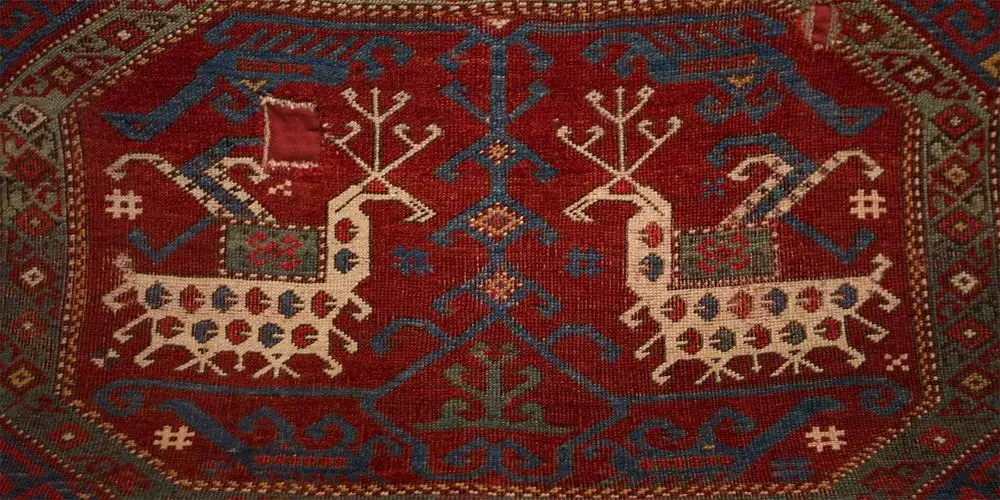
This transformation is particularly interesting because it is not unlike the way memory itself works. When we remember an object, we rarely retain every detail. We keep certain features that allow us to recognise it again.
The result is a form of abstraction that feels remarkably sophisticated, even when it emerged from an entirely practical tradition of village and nomadic weaving.
Why Certain Shapes Keep Returning
Diamonds, lozenges, hooks, stepped lines and zigzags appear repeatedly across Anatolian textile traditions.
Some have accumulated symbolic interpretations, while others may have been used primarily because they were visually effective and technically suited to the weaving process. It is important not to assume that every geometric shape carries one fixed meaning.
Anatolia contains a remarkable variety of regional traditions, and motifs can change their names, forms and associations as they move between communities.What is more useful is to consider why certain shapes are so adaptable.
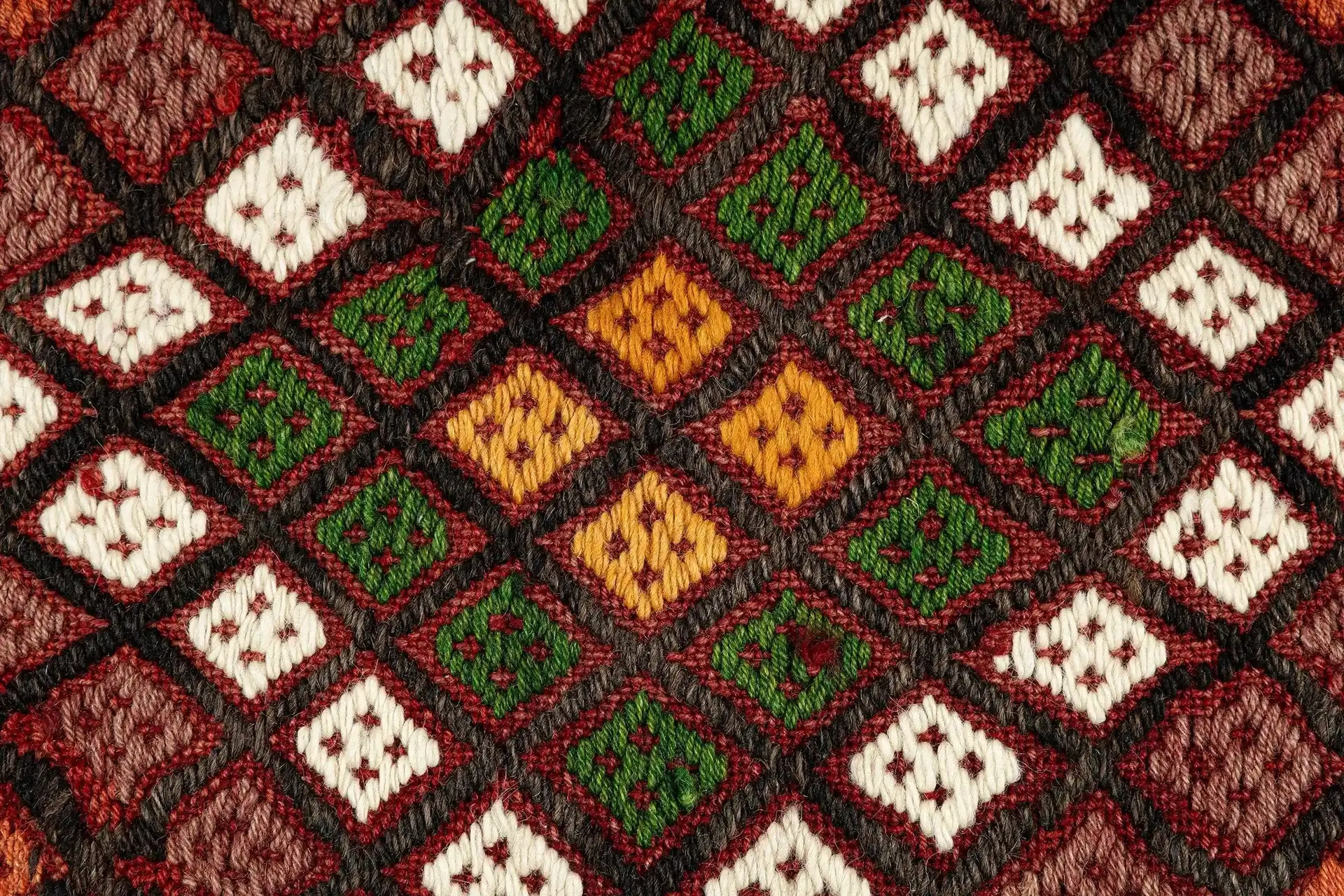
The diamond, for example, can be enlarged to dominate the centre of a composition, repeated into a field, divided into smaller forms or placed within a border. A simple angular shape can therefore become the basis for an intricate visual structure without requiring dozens of unrelated motifs.
The same principle applies to many of the forms found in Turkish kilim designs: complexity often comes not from the number of shapes being used, but from the ways in which a small vocabulary of shapes can be combined, repeated and altered.
Pattern as Memory
There is another reason geometric designs are particularly important in Anatolian weaving: they can be remembered.For much of the history of traditional weaving, patterns were not necessarily transferred through printed design sheets or precise technical drawings. Knowledge was learned through observation, repetition and practice. A young weaver could learn a particular arrangement by watching an older woman work, gradually absorbing the sequence of forms and the rhythm of the pattern.
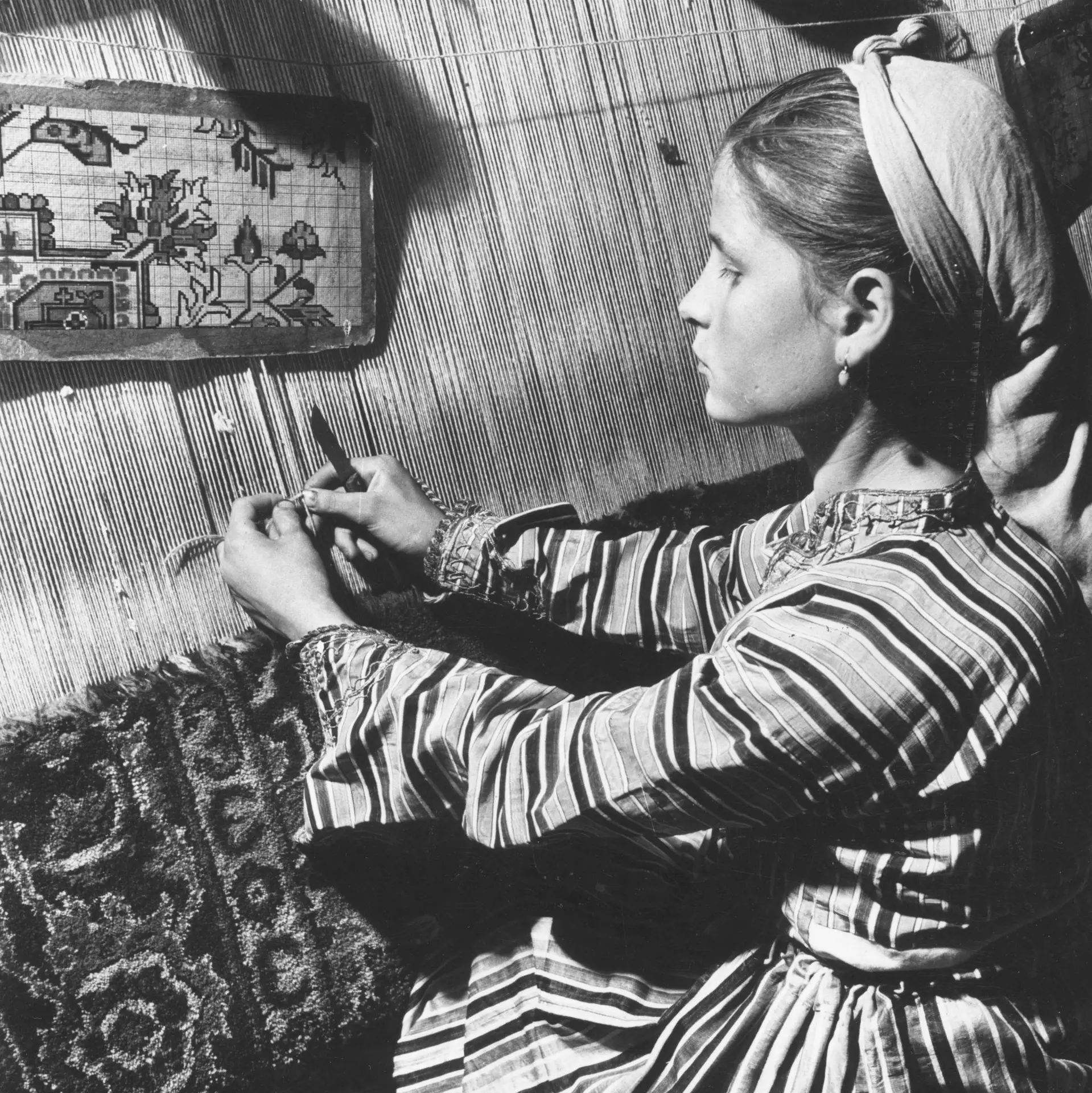
Geometric structures lend themselves remarkably well to this kind of transmission. A sequence of diamonds, hooks or stepped forms can be remembered as a rhythm rather than as a collection of individual details. Once the underlying structure is understood, it can be reproduced and adapted. This helps explain why motifs can remain recognisable across generations without ever appearing exactly identical.
A weaver inherits a pattern, but she also interprets it. The proportions might change, the colours might be different and individual elements might be added or removed. What survives is not necessarily a precise copy but a visual memory.
The Rhythm of Repetition
Look closely at an old Turkish kilim and the repetition rarely feels mechanical. Even when a motif appears many times, there may be subtle differences in spacing, colour or proportion.
One shape may be slightly larger than the next, a line may shift, or the rhythm may change as the weaver moves across the textile. These irregularities are especially valuable because they reveal the human process behind the finished object.
In a machine-made carpet, repetition is usually expected to be exact; in a handmade textile, repetition has a different quality because it passes through a person's hands each time.

This is also why the term handmade Turkish rugs describes more than a production method. It describes a different relationship between design and execution. The pattern exists as a structure, but the person making it remains present within that structure. The geometry gives the weaver a framework. It does not remove her individuality.
Borders Are More Than Decoration
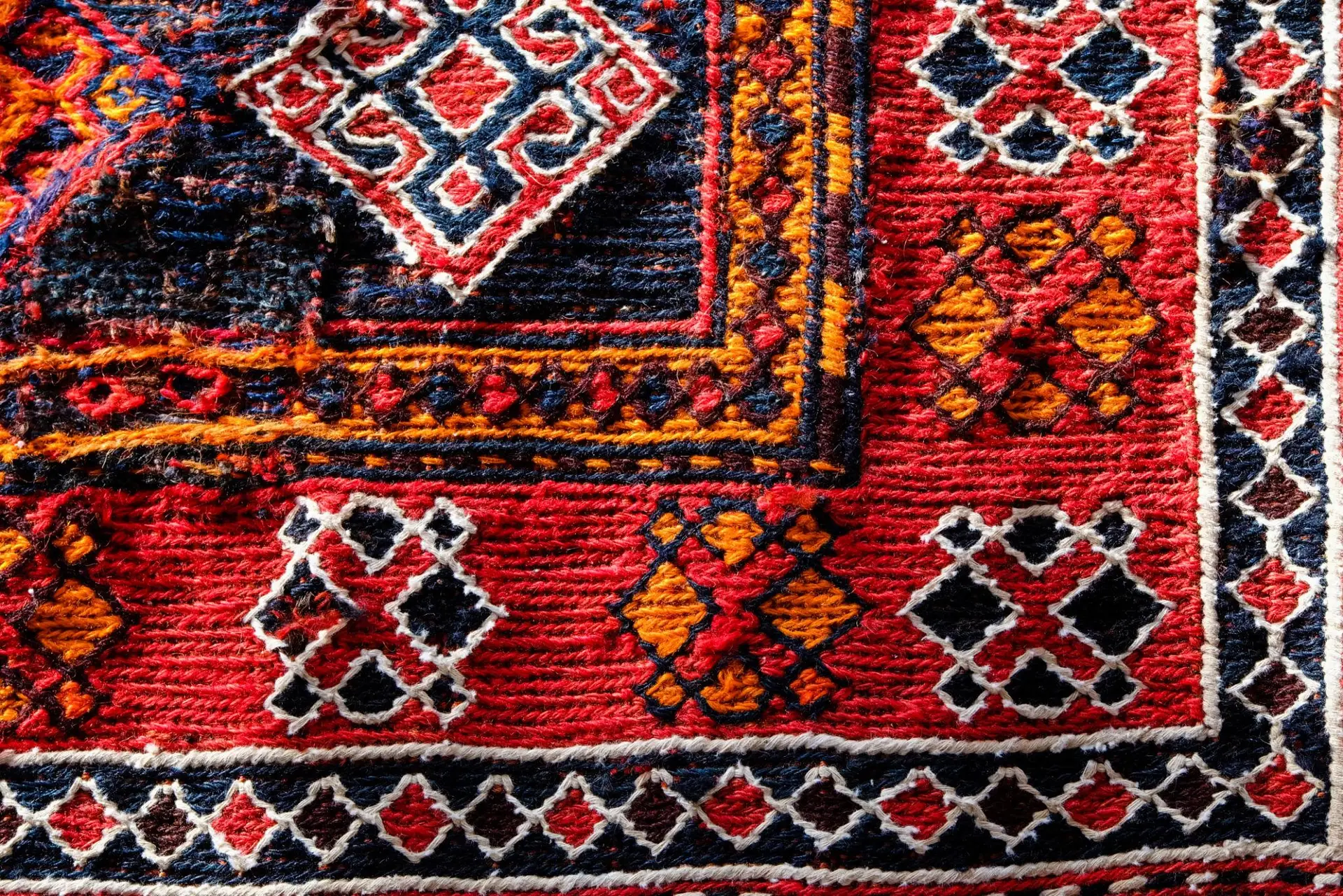
The borders of Turkish kilims deserve particular attention because they demonstrate how carefully geometric pattern can organise a surface.
A border is not simply an ornamental frame around the central field. It establishes rhythm, creates a sense of enclosure and guides the eye around the composition. Many traditional Turkish kilims use several borders, with narrower bands surrounding wider ones before the eye reaches the central field. The effect can be surprisingly architectural. Spaces seem to exist within spaces, almost like rooms within a house.
This is particularly relevant when considering the original function of carpets and kilims. These textiles were used to define physical spaces within homes and tents, creating areas for sitting, sleeping, gathering and daily activities.
Their patterns therefore existed alongside the architecture of domestic life rather than independently from it.
Where Geometry Meets Belief
It is impossible to discuss Anatolian pattern without touching on symbolism, but this is also where caution is needed. Contemporary discussions of Turkish rug motifs and meanings often present a neat catalogue in which every shape has one definitive interpretation. The historical reality is considerably more fluid.

Certain motifs have certainly been associated with ideas such as protection, fertility, continuity, strength or abundance, but their meanings can vary by region and context.
Some forms may have carried strong symbolic significance in one community and functioned more decoratively in another. What is fascinating is the broader cultural practice behind them. Anatolian weavers repeatedly transformed things that mattered to them into visual forms. An object from daily life, an animal encountered in the landscape or an idea connected to family and community could become part of a textile composition.
Geometry provided the means of making that transformation. The symbol did not have to remain recognisable as an illustration. It could become an arrangement of lines and shapes whose original reference was gradually obscured while the pattern itself continued to be passed on.
Why the Imperfections Matter
There is perhaps no better way to understand the difference between a traditional kilim and a modern reproduction than to look at its imperfections. A handmade textile may contain slight variations in colour, tension, spacing and proportion.
Natural wool does not always absorb dye in exactly the same way, and the hand cannot reproduce a shape with the mathematical precision of a machine. For centuries, these variations were simply part of the process. Today, however, they have become part of what makes an authentic Anatolian rug so compelling.
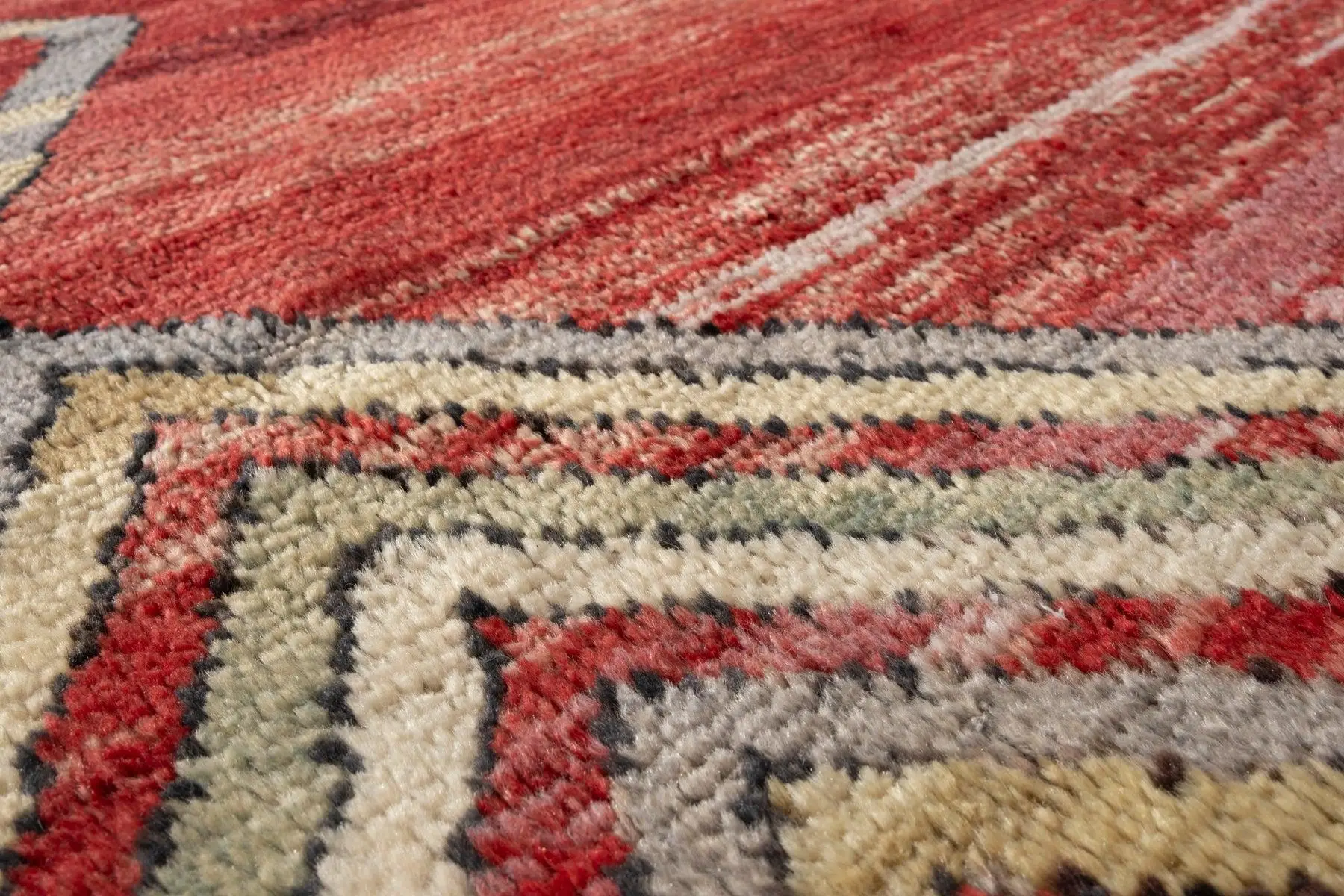
The geometry is not sterile. It is softened by the material and altered by the hand. A pattern can be highly structured while still retaining a sense of movement and irregularity. The tension between order and variation is one of the reasons traditional kilims can feel so alive, even when their designs are centuries old.
Why Turkish Kilims Still Look Modern
There is an amusing contradiction in the contemporary popularity of Turkish kilims. Many of the qualities that make them attractive to modern interiors, such as abstraction, repetition, restrained geometry and strong visual structure, existed in Anatolian weaving long before contemporary design adopted them.
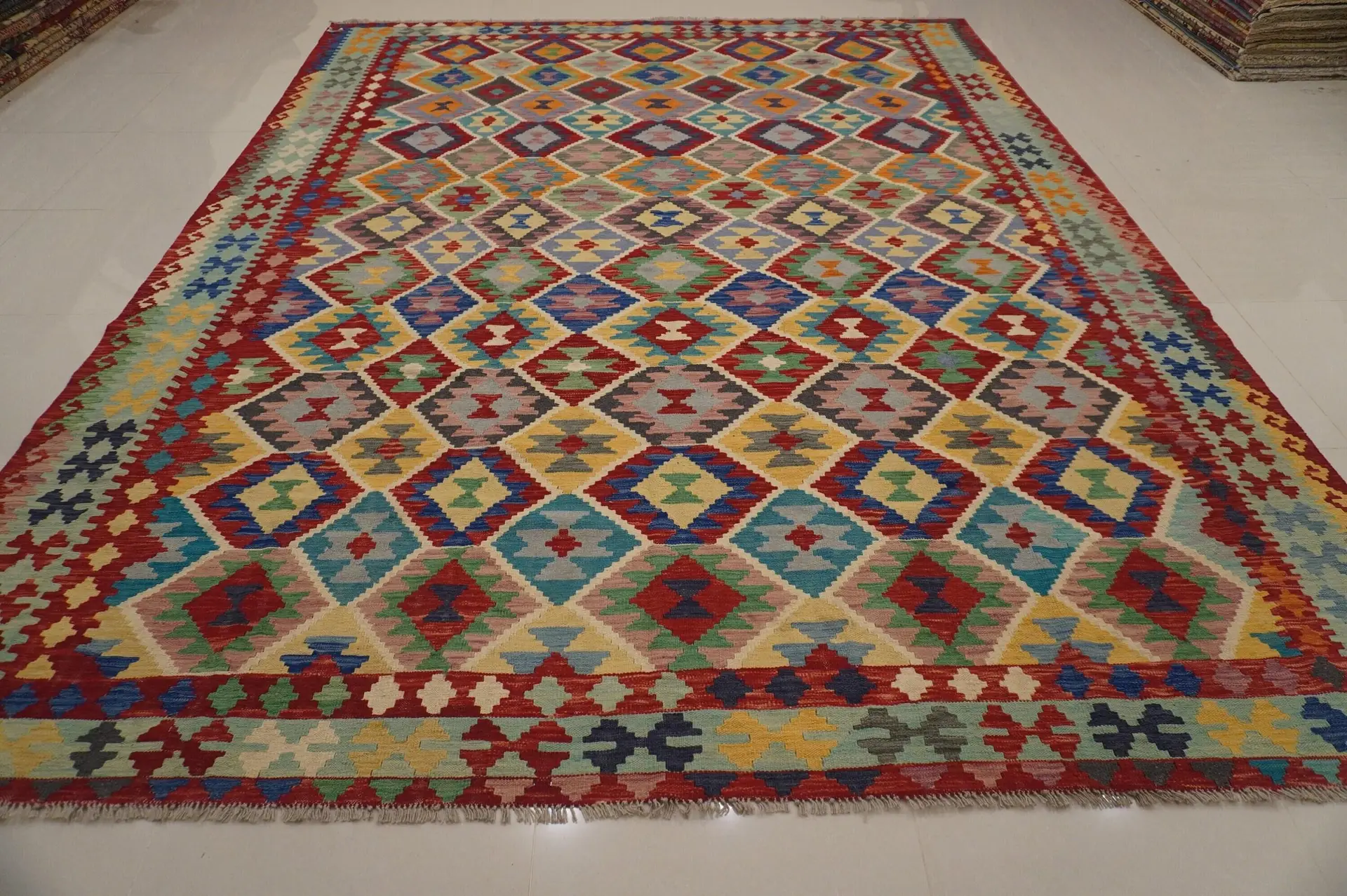
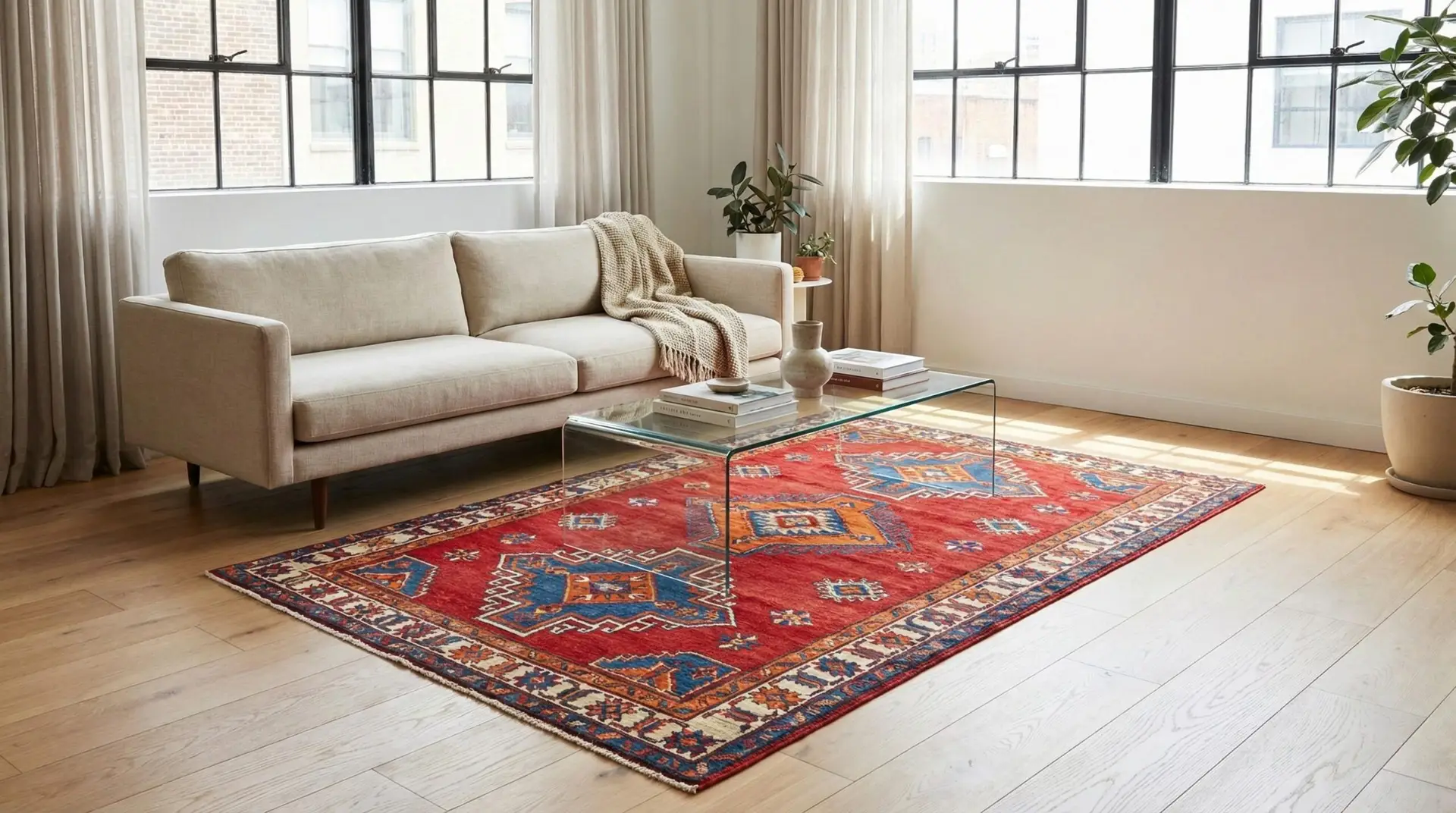
A geometric kilim can sit naturally within a minimalist room because its design is not dependent on realistic imagery or elaborate ornament. It can introduce pattern without overwhelming the surrounding space, and its irregularities can soften the precision of contemporary architecture.
Yet its geometry has a history that reaches far beyond modern taste.
What looks modern to us may simply be something very old that has never stopped working.